
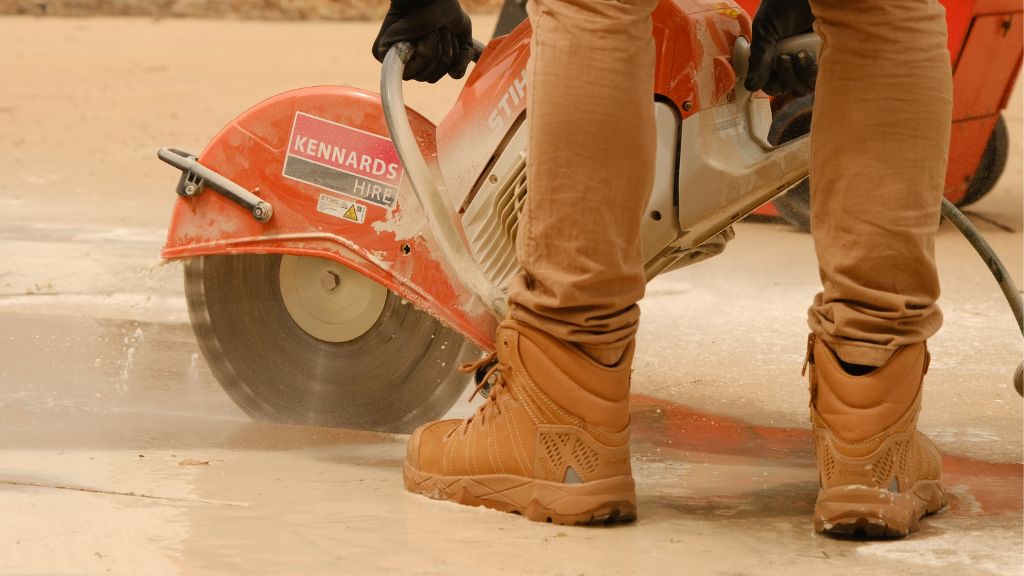
Wet or dry isn’t a minor preference. Instead, it directly changes how tools behave, how dust is managed, and how predictable the final result will be on site.
In concrete work, cutting and surface grinding are often grouped together. However, they solve different problems in very different ways. When contractors treat them as interchangeable, tools wear faster, dust control suffers, and unnecessary risk increases across the job site.
Wet vs Dry: Diamond Blade Cutting
Concrete cutting is where the wet vs dry conversation usually begins.
Dry cutting is often chosen for speed and simplicity. For example, there’s no water setup, no slurry to manage, and fewer variables at the start. However, heat builds quickly. Blades wear faster, dust becomes airborne immediately, and visibility can deteriorate within minutes. As a result, what starts as a quick setup can lead to blade fatigue, compliance issues, and unplanned downtime.
Why Contractors Cut Wet
Wet cutting introduces control directly at the point of contact:
Water cools the blade and limits heat buildup
Dust is suppressed at the source rather than released into the air
The cut remains more stable and consistent
It is safer when dealing with hazardous dusts like silica
Reduced friction helps extend blade life
Because of this, wet cutting isn’t about slowing productivity. Instead, it helps manage energy, dust, and wear in a way that matches the concrete slab in front of you.
Wet vs Dry: Surface Preparation and Grinding
In contrast, surface grinding tools like cup wheels operate under different constraints.
Grinding is almost always done dry—not because dust isn’t a concern, but because water creates new problems. Water introduces slurry, reduces visibility, and limits control. Therefore, effective grinding depends on shrouds and high-performance dust extraction systems.
Shrouds, airflow, and powerful vacuum systems actively pull fine particles away from both the wheel and the operator. In this case, dust control is built into the grinding system rather than applied through water. Consequently, the quality of a grind depends just as much on airflow and extraction as it does on the cup wheel itself.
The Core Difference
Cutting controls heat and dust with water
Grinding controls dust with airflow and extraction
Ultimately, both methods manage the same risk—but they do so in fundamentally different ways. Understanding that difference leads to safer sites, longer tool life, and more predictable outcomes on every slab.